
Introduction: When Silence Hurts Louder Than Words
Your teen keeps checking their phone.
They swear they’re “fine.”
But you notice the withdrawal, the irritability, the quiet sadness.
No breakup announcement.
No argument.
Just… nothing.
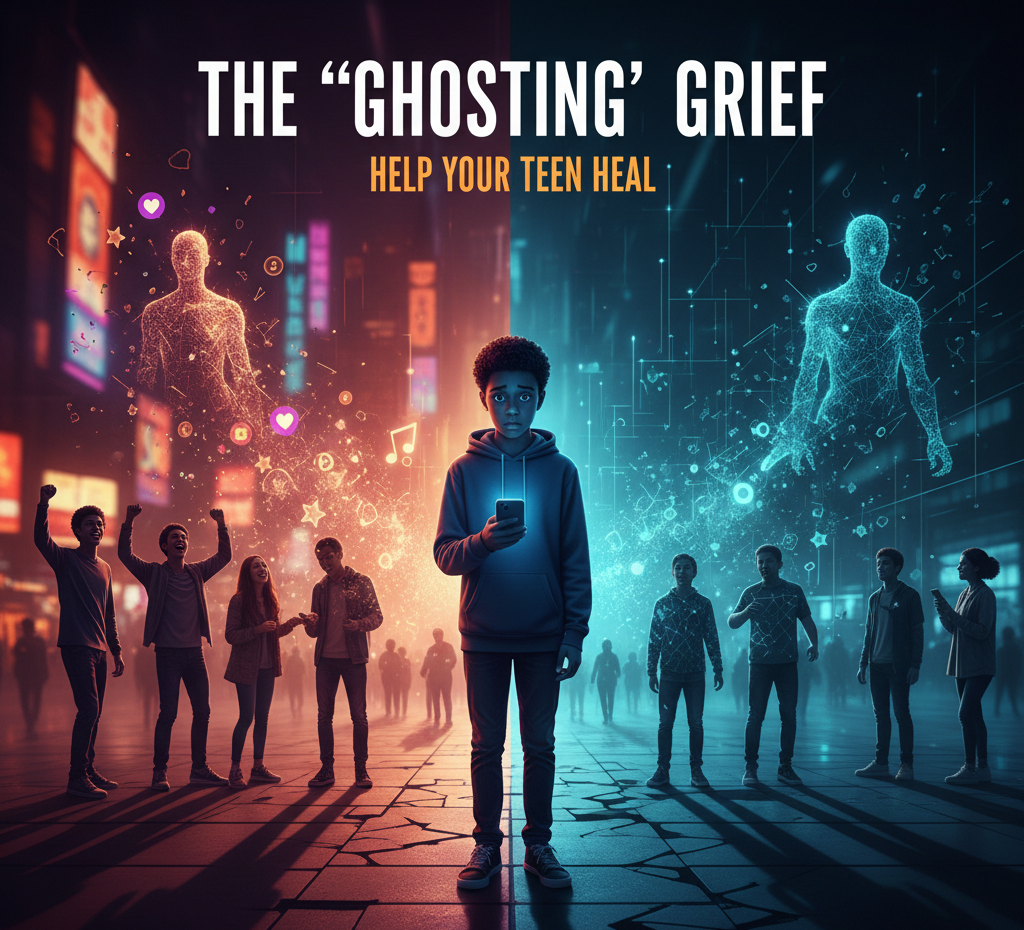
Welcome to The “Ghosting” Grief: How to help your teen process the unique trauma of being suddenly ignored online.
Ghosting—when someone abruptly cuts off communication without explanation—has become a defining emotional experience of the digital age. For teens, whose social worlds are largely online and whose identities are still forming, ghosting isn’t just awkward or disappointing. It can feel devastating.
This isn’t about teenage drama. It’s about unresolved loss, identity confusion, and a kind of grief that adults often underestimate because there’s no visible ending.
Let’s unpack why ghosting hits teens so hard—and how parents can help them heal without minimizing their pain.
Why Ghosting Feels So Different (and So Painful) for Teens
The Brain Science Behind the Pain
Adolescent brains are wired for social belonging. According to research from the American Psychological Association, teens experience social rejection more intensely than adults because the brain regions tied to emotional processing and reward are still developing.
When a teen is ghosted:
- Their brain registers it similarly to physical pain
- The lack of explanation keeps the stress response activated
- There’s no emotional “closure” to process
In other words, ghosting doesn’t allow the brain to finish the story.
Ghosting vs. Traditional Rejection
| Traditional Rejection | Ghosting |
|---|---|
| Clear ending | No ending at all |
| Explanation (even if painful) | Silence and ambiguity |
| Opportunity for closure | Endless rumination |
| External reason | Internal self-blame |
This ambiguity is what turns ghosting into grief, not just rejection.
The Hidden Grief Adults Often Miss
When adults hear about ghosting, the instinct is often:
“That’s just how kids communicate now.”
But teens aren’t grieving the person alone—they’re grieving:
- The imagined future
- The version of themselves that felt chosen
- The sense of safety in relationships
Psychologists call this ambiguous loss, a concept explored by family therapist Pauline Boss and referenced by institutions like the Harvard Graduate School of Education.
Ambiguous loss is especially hard because:
- There’s no clear reason
- There’s no ritual for closure
- The teen feels silly for being “this upset”
So they suffer quietly.
Signs Your Teen Is Struggling With Ghosting Grief
Not every teen will say, “I’ve been ghosted and it hurts.”
More often, you’ll see:
- Sudden withdrawal from friends or family
- Obsessive checking of messages or social media
- Irritability or emotional numbness
- Drop in confidence (“I’m annoying,” “I’m boring”)
- Avoidance of new connections
If you’re seeing these patterns, the silence online may be echoing loudly inside them.
How to Help Your Teen Process the Trauma of Being Ghosted
1. Validate the Pain—Without Fixing It
One of the most powerful things you can say:
“That kind of silence can really hurt.”
Avoid:
- “You’ll get over it”
- “They weren’t worth it anyway”
- “At least nothing bad happened”
To a teen, something bad did happen. They were emotionally erased.
Validation helps calm the nervous system and signals safety.
2. Help Them Name the Loss
Teens often feel confused because ghosting doesn’t “count” as a breakup.
Try gently naming it:
- “It sounds like you’re grieving the connection you thought you had.”
- “It makes sense to feel sad when something ends without explanation.”
Naming the experience turns chaos into something understandable—and survivable.
3. Interrupt the Self-Blame Spiral
Ghosting invites dangerous internal narratives:
- What did I do wrong?
- If I were better, they wouldn’t have left.
Help your teen reality-check:
- Ghosting is about avoidance, not worth
- Silence says more about the ghoster’s coping skills than your teen’s value
You might say:
“People ghost when they don’t know how to handle discomfort—not because the other person failed.”
4. Teach Closure Without Contact
One of the hardest lessons: closure doesn’t come from the other person.
Healthy alternatives:
- Writing a letter they don’t send
- Talking through “what I wish I could say”
- Creating a symbolic ending (deleting a chat, unfollowing)
These rituals help the brain complete the emotional loop.
Digital Relationships Are Real Relationships
A common myth:
“Online relationships aren’t that serious.”
For teens, they absolutely are.
Friendships, crushes, and emotional bonds formed online activate the same attachment systems as in-person relationships, according to research published in journals like Cyberpsychology, Behavior, and Social Networking.
When those bonds disappear without warning, the nervous system reacts the same way it would to any sudden loss.
Helping Teens Build Emotional Resilience After Ghosting
Skills That Matter More Than Toughness
Resilience isn’t about “not caring.”
It’s about recovering without self-destruction.
Support your teen in learning:
- Emotional literacy (naming feelings)
- Boundary-setting in digital spaces
- Discernment (who earns access to their vulnerability)
These are life skills—not just teen survival tools.
What Not to Do (Even With Good Intentions)
Avoid:
- Contacting the ghoster on your teen’s behalf
- Forcing social replacement (“Just hang out with someone else”)
- Monitoring their phone excessively
These responses can unintentionally reinforce shame or helplessness.
Visual Insight: Why Ghosting Hits Teens Harder
📸 Suggested Infographic:
“Why Ghosting Hurts the Teenage Brain”
Include:
- Brain development timeline
- Social reward sensitivity
- Impact of unresolved endings
📊 Adult vs. Teen Responses to Ghosting
| Feature | Adult Response | Teen Response |
| Emotional Regulation | Generally able to use “Cognitive Reframing” (e.g., “They must be busy” or “This is about their maturity, not my worth”). | Dominated by the Limbic System; emotions feel intense, immediate, and world-ending. |
| Identity Impact | Identity is largely established. Ghosting is seen as a social inconvenience or a minor bruise to the ego. | Identity is under construction. Ghosting is often internalized as a fundamental flaw: “I am unlovable” or “I am invisible.” |
| Coping Strategies | Likely to set boundaries, delete the number, or talk it out with a partner/friend. | Prone to “Digital Surveillance” (obsessively checking read receipts, “last active” status, and the ghoster’s other social feeds). |
| Perception of Closure | Understands that “no response is a response” and can find closure internally. | Struggles with Ambiguous Loss; requires external validation or a “reason why” to stop the mental loop. |
Turning Pain Into Growth (Without Romanticizing It)
Ghosting can become a powerful learning moment if teens are supported correctly.
Many teens eventually learn:
- Silence is a boundary—even when it’s cruel
- They can survive unanswered questions
- Their worth isn’t determined by access to someone else
But they don’t learn this alone.
They learn it through co-regulation, modeling, and patience.
Conclusion: Be the Place Where the Silence Ends
The most healing thing you can offer your teen isn’t advice—it’s presence.
When the world disappears without explanation, you can be the constant that stays.
The “Ghosting” Grief: How to help your teen process the unique trauma of being suddenly ignored online starts with one powerful message:
“Your feelings make sense. And you don’t have to go through this alone.”
That’s how grief softens.
That’s how resilience forms.
That’s how teens learn they are still worthy—even when someone chooses silence.
💬 Have you seen your teen struggle after being ghosted?
Share your thoughts or experiences in the comments—your insight could help another parent feel less alone.
📩 Want more evidence-based guidance on teen mental health and digital wellbeing?
Subscribe to our newsletter for weekly tools, research-backed strategies, and compassionate parenting insights.
🔗 Explore related reads:
- Helping Teens Navigate Online Rejection
- Why Digital Boundaries Matter for Mental Health
You’re not overreacting.
And your teen isn’t “too sensitive.”
This matters—and so do they.